
Luce County Probate and Family Court
Probate matters in Luce County run through the Probate and Family Court, based at the county courthouse in Newberry. The presiding judge is the Hon. W. Clayton Graham. Daily filings, file lookups, and certified copies are handled by the Probate Registrar. Cases that touch minors, juvenile guardianship, or delinquency also reach the court's Juvenile Officer. One courthouse holds nearly all public court access for this small Upper Peninsula county, so most probate questions lead to the same building on West Harrie Street.
The court's own website lists its judge, phone lines, hours, and the case types it hears. The Luce County Probate and Family Court page is the best starting point for anyone unsure where a case belongs.
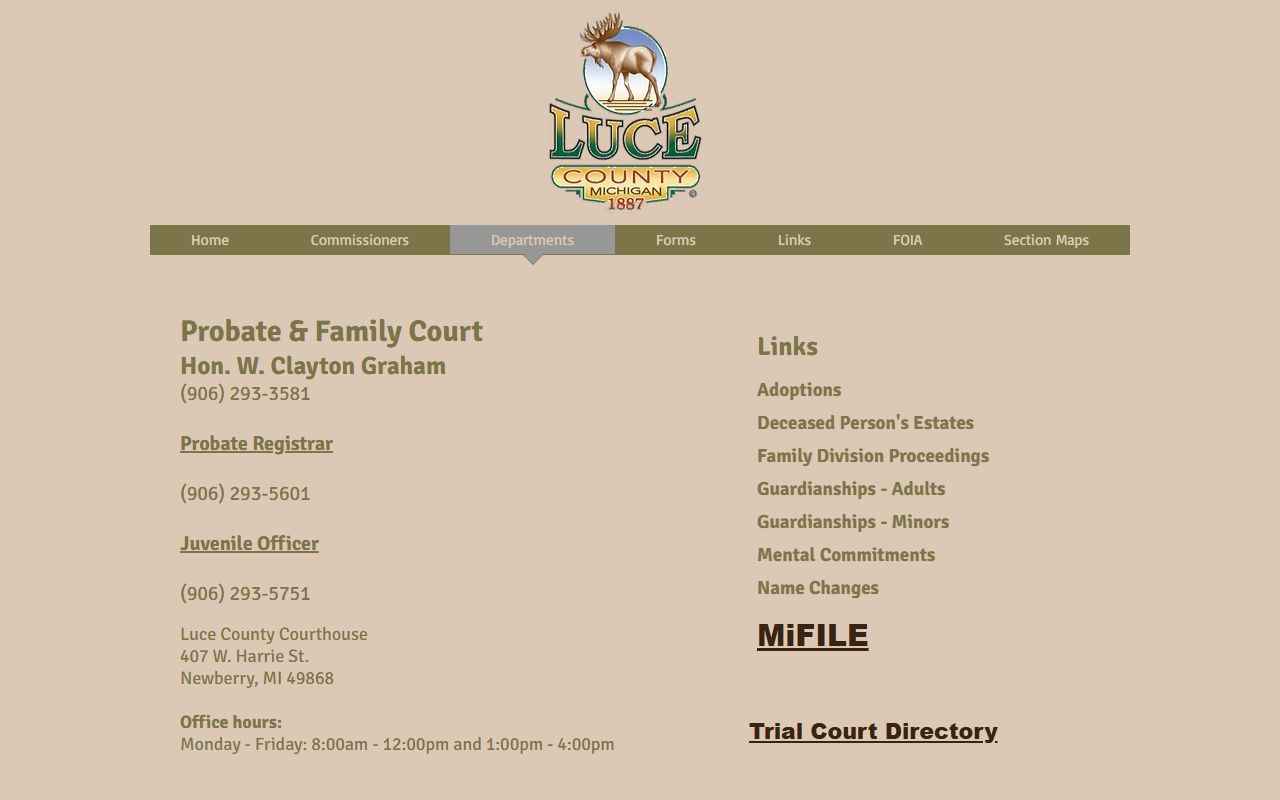
That page names the topics the court oversees and the direct numbers for each function. Because the same address serves the circuit, district, and probate benches, callers should ask for the Probate Registrar by name to avoid being routed to the wrong counter.
Luce County Probate and Family Court
Luce County Courthouse
407 West Harrie Street
Newberry, MI 49868
Probate Registrar: (906) 293-5601
Juvenile Officer: (906) 293-5751
Judge: Hon. W. Clayton Graham
Hours: Mon-Fri 8:00 a.m. to 12:00 p.m. and 1:00 p.m. to 4:00 p.m.
What Luce County Probate Covers
Probate is the court process for handling what a person leaves behind and for shielding people who cannot protect themselves. In Luce County the Probate and Family Court covers a set of closely linked matters. Most spring from a death, a disability, or a change in legal status. The court both opens estate cases and keeps the files that record how each one closes.
The topics the court lists on its public page give a clear map of what it hears:
- Deceased person's estates and wills
- Adult guardianships
- Minor guardianships
- Conservatorships
- Mental commitments
- Adoptions
- Name changes
Adoptions and juvenile files sit inside this same Luce County court but carry heavy privacy limits, so they are not open to a general public search. Estate and name-change files are more often reachable, though even those can hold sealed or redacted parts.
Probate Terms Defined
Probate paperwork leans on a handful of legal words. A short plain-language guide makes Luce County estate and guardianship filings much easier to read, and the same terms show up across Luce County probate cases.
- Testator
- The person who made a will. When that person dies, the will speaks for how the estate should pass.
- Executor / Personal Representative
- The person the court names to collect assets, pay debts, and hand out what remains. Michigan mostly uses the term personal representative.
- Intestate
- Dying with no valid will. State law then decides who inherits.
- Guardianship
- A court order that puts one person in charge of the care and daily needs of an adult or child who cannot decide for themselves.
- Conservatorship
- A court order that puts one person in charge of another's money and property, often called a protective proceeding.
- Letters of Authority
- The court paper that proves a personal representative or guardian may act. Banks and agencies ask to see it.
Luce County Estate Records and Wills
A Luce County deceased estate file is the fullest kind of probate record. It gathers the petition that opens the case, the original will when one exists, a reference to the death, and a list of interested persons. From there it grows to hold the order of appointment, the letters of authority, an inventory of assets, filed claims, accountings, distributions, and the papers that finally close the estate.
The Luce County court draws a sharp line about original wills. The Deceased Person's Estates page tells families that anyone holding an original will must deliver it to the Probate Court, even when no estate will be opened. That duty catches many people by surprise, since a will still has to reach the court whether or not a full case follows.
Deciding how to settle an estate is a separate step. A family may face formal probate, informal probate, a small-estate shortcut, or another way to move title. Court staff can supply forms and explain filing steps, but they draw a firm boundary on advice.
Note: An estate case and a marriage or divorce file are kept by different offices, so estate copies come from the Probate Registrar while spousal records may route through the county divorce records channels.
Guardianships and Conservatorships
Guardianship and conservatorship cases in Luce County protect people who cannot fully care for themselves or their money. A guardianship covers the person, meaning care, housing, and daily needs. A conservatorship covers the estate, meaning bank accounts, benefits, and property. One person may hold both roles, or the Luce County court may split them.
Adult guardianship files usually contain a petition, a physician or medical report, a record of the hearing, the order of appointment, and yearly reports on the person's condition. Minor guardianship files add parental consent or notice and a social history form. Conservatorship files carry a petition, a protective order, an inventory, a bond, accountings, and orders that allow the sale of property. Because these matters affect vulnerable people, the court reviews annual reports and accountings to confirm the arrangement still fits.
Not every part of these files is open. Medical and physician reports in an adult guardianship may be confidential. The social history form in a minor guardianship is closed under Michigan records standards. The docket and the basic orders are often reachable, while the sensitive attachments are held back.
Mental Commitments and Restricted Records
The Luce County Probate and Family Court also hears mental commitment cases, which decide whether a person needs court-ordered treatment. These files hold petitions, clinical reports, and orders, and they carry some of the strongest privacy protection in the whole court. Michigan records standards treat this mental-health material as nonpublic or tightly limited, so the public may learn little beyond the bare fact that a case exists, and only where the law allows even that.
Several other probate categories sit behind similar walls. Adoption records are a restricted class and should never be treated as a public search. Access usually calls for statutory eligibility, a court process, or the state's adoption-record procedures. Juvenile files under the Juvenile Code are also closed to the general public, and clerks may simply state that no public record is available.
These limits flow from court rule and statute rather than office preference. Protected personal identifiers, such as birth dates, Social Security numbers, financial account numbers, and confidential addresses, may be redacted from any file before release. When in doubt about what may be shared, the Probate Registrar can say whether a specific record is open.
Note: A blank result on a mental-health or adoption case does not mean no case exists, since the law may bar staff from confirming a restricted file at all.
Luce County Name Change Records
Name changes are part of the family docket at the Luce County Probate and Family Court. A person files a petition, the court holds a hearing, and an order grants the new name if the request meets state standards. The petition and the resulting order form the core of the file.
Most adult name-change orders are public, and the Luce County court keeps them like other family-division records. Safety can change that. When a name change ties to domestic violence or another risk, the court may seal parts of the file to protect the person. Anyone tracing a name change should ask the Probate Registrar whether a given case is open or sealed before assuming the record can be pulled.
How to Search Luce County Probate Records
There is no single public database that shows every Luce County probate file, so a search usually blends an online lookup with a direct call to the court. Start with the statewide index, then reach the registrar for anything the index does not show. The steps below fit most estate, guardianship, and name-change lookups.
- Open MiCOURT Case Search and search by party name or case number. Probate cases may appear depending on the court, and the site uses an hCaptcha check before results load.
- Confirm the court through the MiFILE available courts list, which names the Luce County Probate Court at 407 West Harrie Street, Newberry.
- Call the Probate Registrar at (906) 293-5601 for a file lookup, certified copies, current filing requirements, and questions about restricted records.
- Visit the Probate Court at 407 West Harrie Street during posted probate hours to view a public file or request copies in person.
The online index is best for confirming that a case exists and reading its docket. Document images, certified copies, and any judgment call about a sealed record still run through the court itself. For that reason a Luce County probate records search often opens on a screen and finishes on the phone.
Requesting Luce County Probate Copies
Copies of Luce County probate documents come from the court that holds the file. The county's public fee schedule sets a flat charge for certified copies, which are the copies most agencies and banks will accept for legal use. Plain copies for personal reference cost less, and probate filing fees are set by Michigan statute, so the registrar can confirm the current amount for a given petition.
| Item | Amount |
|---|---|
| Certified copy, first page | $10 |
| Certified copy, each additional page | $1 |
| Probate filing fees | Set by Michigan statute; confirm with the Probate Registrar |
If the court does not offer a local packet for a filing, statewide forms fill the gap. Michigan's State Court Administrative Office publishes probate forms through the Michigan Courts website, and the county's own clerk fee details spell out certified-copy pricing for court-section records. Checks and money orders are made payable to the county office that takes the request.
Note: A certified copy carries the court seal and is the version accepted for legal steps such as transferring title, while an uncertified copy is fine only for reference.
Historical Luce County Probate Records
Older Luce County estate and probate files may not appear in any online index. Genealogists and heirs tracing a long-closed estate have two solid paths. The first is the registrar, who can check whether a paper file still lives at the courthouse. The second is the state archive, which holds many original county records once they age out of active use.
The Archives of Michigan keeps a Luce County guide that organizes historical county records by type, date range, and record-group number. It is the right tool for deep genealogical or historical Luce County estate research, especially when a case predates modern electronic records. Ask the Probate Registrar first for anything that might still sit at the courthouse, then turn to the archive for the oldest material. For related family and vital records that support an estate search, the county court records overview points to the other offices that may hold pieces of the story.