
Criminal Court Records in Luce County
A Luce County criminal court record is the case file a court clerk opens the moment charges are filed. In Luce County, that file holds every formal step in one criminal case. It starts with the charging document and grows with each hearing, motion, and order. The Luce County clerk keeps the record current until the case closes, and often long after. A criminal court record is not the same as an arrest report. The arrest is one event. The court record is the full case built around the charges the prosecutor brings. For a closer look at the offenses filed against a person, the Luce County court charge records break the charges down count by count.
Two trial courts handle criminal cases in Luce County. The 92-1 District Court in Newberry takes misdemeanors, which are crimes punishable by up to one year in jail. It also handles the early stages of felony cases, including the first appearance and the probable cause hearing. The 11th Circuit Court handles Luce County felonies once they move up from District Court. Judge Brian Rahilly presides over circuit matters. The split matters for anyone searching Luce County criminal court records, because a felony can leave a file in both courts. To see the wider set of filings beyond criminal cases, the broader Luce County court records page also covers civil, family, and probate files.
How to Search Luce County Criminal Court Records
Most Luce County criminal court records start with the state's online index. Michigan runs MiCOURT Case Search, a free public tool that lists cases from the 11th Circuit Court and the 92-1 District Court. A search returns the case number, party names, filing dates, and the register of actions for Luce County cases. The portal shows index and docket data, not a full image of every document. For certified copies or sealed-file questions, the clerk's counter is still the place to go.
- Open MiCOURT Case Search and choose the case-search option.
- Enter the defendant's name, or a case number if you already have one.
- Filter by court, case type, and date range to narrow the list.
- Open a matching case to read the docket, charges, and disposition.
- Request a certified copy from the County Clerk or the 92-1 District Court when you need an official record.
MiCOURT does not replace the clerk. Older cases, sealed files, and full document images may not appear online. When the index falls short, call the office that holds the file. County Clerk Sharon J. Price keeps circuit criminal files at (906) 293-5521. The 92-1 District Court handles district criminal and misdemeanor files at (906) 293-5531. A written request under Michigan's open-records law can also reach non-court records held by county offices.
Stages of a Luce County Criminal Case
A Luce County criminal case moves through set stages, and each one adds to the record. In Michigan, felonies begin in District Court and then bind over, which means they transfer up to Circuit Court after a judge finds probable cause. Misdemeanors stay in District Court from start to finish. Tracking these stages helps a reader place any single docket entry in the life of the case.
Case flow: Charges Filed › Arraignment › Preliminary Exam or Pretrial › Plea or Trial › Disposition › Sentencing. In Luce County, felony cases open in the 92-1 District Court and bind over to the 11th Circuit Court, while misdemeanors run their full course in District Court.
| Stage | What Happens |
|---|---|
| Arraignment | The first court appearance. The judge reads the charges, sets or reviews bond, and takes an early plea. |
| Preliminary Exam / Pretrial | In felony cases, a District Court judge weighs probable cause for bindover. In other cases, the parties handle motions and scheduling. |
| Plea or Trial | The defendant enters a plea, or the case goes to trial before a judge or a jury. |
| Sentencing | After a conviction or plea, the court sets the penalty, such as jail, probation, fines, or restitution. |
Note: A felony that binds over from the 92-1 District Court can leave a file in both that court and the 11th Circuit Court, so check the record in each.
What a Luce County Criminal Court Record Shows
A Luce County criminal court record packs many fields into one file. Some describe the parties. Others track each event and the final outcome. The register of actions ties it together as a dated list of everything filed and ordered. The fields below are the ones most useful for a public search of Luce County criminal court records.
| Field | What It Shows |
|---|---|
| Case Number | The court's unique ID for the case, tied to the court and case type. |
| Defendant | The person charged, sometimes with aliases and a birth year. |
| Charges | Each offense by name, statute, count, and whether it is a misdemeanor or felony. |
| Bond | The amount or conditions set to secure the defendant's return to court. |
| Plea | The defendant's response, such as guilty, not guilty, or no contest. |
| Disposition | The final outcome of each charge, such as a conviction, dismissal, or acquittal. |
| Sentence | The penalty imposed after a conviction, from fines to jail or probation. |
| Register of Actions | The dated log of filings, hearings, motions, and orders in the case. |
Certain details are stripped before a file goes public. Under MCR 1.109, clerks protect personal identifying information such as Social Security numbers, birth dates, financial account numbers, and minor names.
The Prosecutor's Role in Luce County Charges
Charges do not land in a Luce County criminal court record by chance. The Luce County Prosecuting Attorney decides which charges to file. Lauren Dye-Clark holds that office and reviews police reports before authorizing a case. Her office appears in District Court for misdemeanor and felony preliminary matters, then carries felony prosecutions into Circuit Court. The prosecutor, not the arresting officer, turns an arrest into a formal court charge.
Staffing behind the office shifted in recent months. On October 21, 2025, the Michigan Attorney General began supporting Luce County prosecutorial functions after former prosecutor Thomas Evans left for another county post. The current county page lists Lauren Dye-Clark as Prosecuting Attorney, reachable at (906) 293-3277. The office also serves crime victims. Wendy Osterhout works as office manager and victim advocate on that same line.
Charges vs. Convictions
A charge is an accusation. A conviction is a proven result. A Luce County criminal court record can show charges that never led to a conviction. Luce County cases end in many ways. A charge may be dropped, dismissed, reduced, or beaten at trial. The record keeps that history even when the defendant walks free. This is why reading a full file matters more than reading one charge line.
| Charge | Conviction | |
|---|---|---|
| Stage | Accusation | Verdict or plea |
| Burden of Proof | Probable cause | Beyond reasonable doubt |
| Who Decides | Prosecutor files it | Judge or jury |
| Public Record | Yes | Yes |
| Effect | No finding of guilt yet | Legal finding of guilt |
A dropped charge is not proof of innocence, and a charge alone is not proof of guilt. Read the disposition line for each count before you draw a conclusion.
Note: A single Luce County case can list several charges, and each charge can reach a different disposition, so review every count in the file.
Reading Dispositions and Sentences
The disposition is the bottom line of each charge in a Luce County file. It tells you how that count ended. Common Luce County dispositions include guilty, not guilty, dismissed, and no contest, which Michigan courts call nolo contendere. A no contest plea accepts the penalty without admitting guilt. Some cases end in a deferred outcome, where the court holds judgment while the defendant meets set conditions. If those conditions are met, the charge may be dismissed.
- Arraignment
- The first court appearance, where charges, rights, and bond are addressed.
- Bindover
- The transfer of a felony from District Court to Circuit Court after a probable cause finding.
- Disposition
- The final outcome of a charge or a case.
- Sentence
- The punishment or terms ordered after a conviction.
- Probation
- A supervised sentence served in the community instead of jail.
A sentence line can list several parts. Jail time, probation length, fines, court costs, and restitution may all appear. Restitution is money paid back to a victim. Probation files themselves are not public in Michigan, so the record shows the sentence terms but not the internal probation file.
Sealed vs. Set-Aside Records
Not every Luce County criminal court record stays open forever. Two paths can limit public view. A sealed record is closed by court order but still exists. A set-aside record, which Michigan uses in place of the word expungement, is treated as though the conviction never happened for most purposes. Michigan law says set aside, so that is the term you will see on court forms.
| Sealed | Set-Aside (Expunged) | |
|---|---|---|
| Visibility | Hidden from public view | Removed from the public criminal record |
| Law Enforcement | Limited access | Retained access for allowed purposes |
| Governing Rule | MCR 8.119(I) | MCL 780.621 |
| Eligibility | Court order on a showing of good cause | Eligible convictions after a waiting period |
Some convictions can never be set aside, no matter how much time passes. The list of convictions ineligible under MCL 780.621c spells out which offenses stay on the record for good.
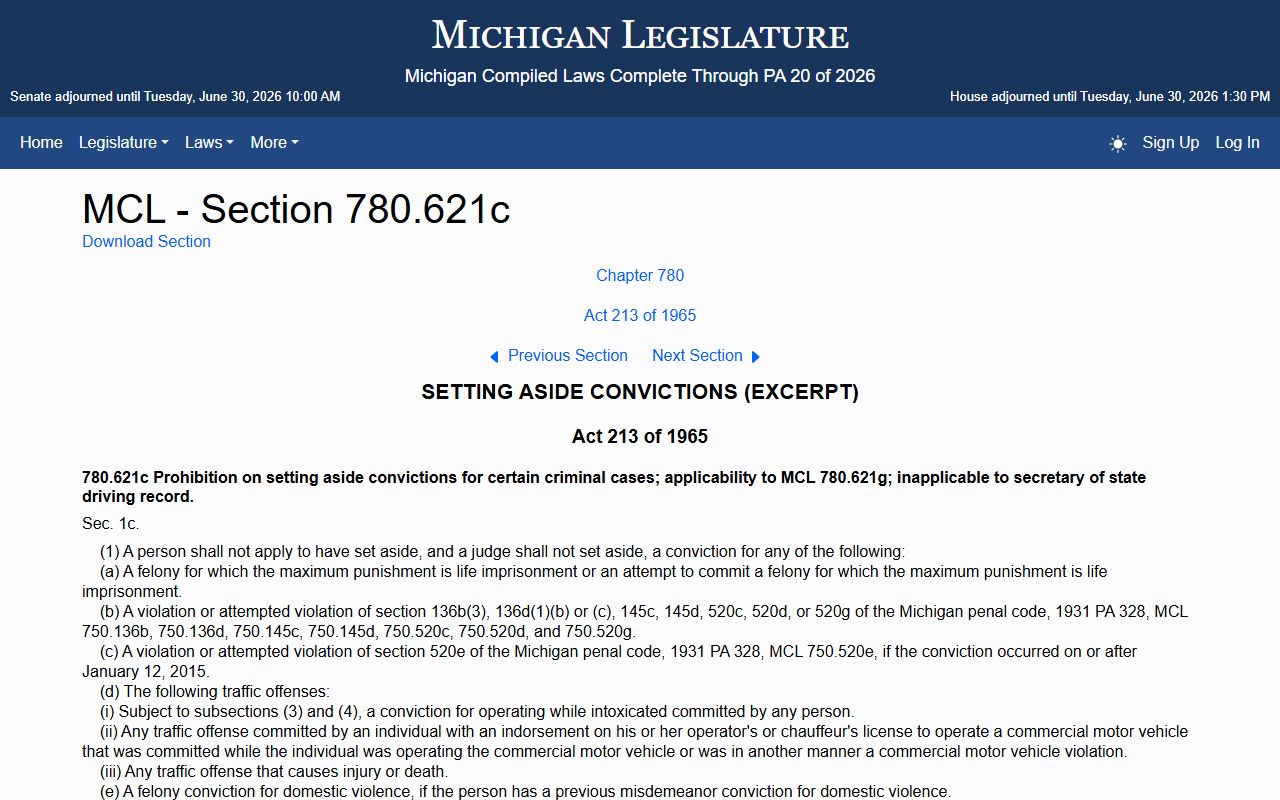
Serious offenses, such as certain violent crimes and sex offenses, sit on that ineligible list, so a set-aside is not an option for every Luce County case.
Setting Aside a Luce County Conviction
Clearing a Luce County conviction is a court filing, not a records request. The process asks a judge to set aside an eligible conviction under state law. It starts with knowing the exact Luce County court and case number. From there, the steps run through fingerprints, prosecutor notice, and a judge's decision.
The core rule sits in MCL 780.621, which governs how a person applies to set aside an eligible conviction.
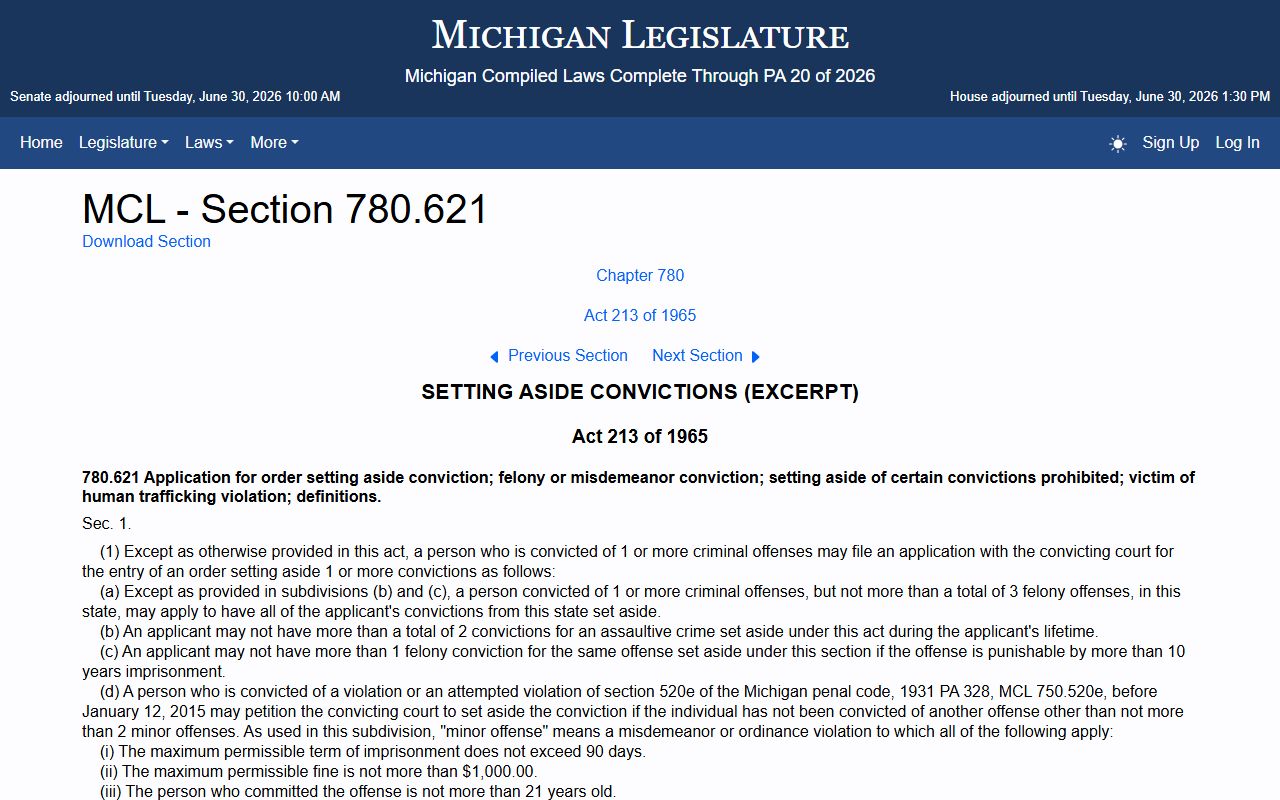
Reading the statute first shows whether a conviction qualifies before any paperwork gets filed.
- Find the exact conviction court and case number through MiCOURT, the 92-1 District Court, or the 11th Circuit Court.
- Compare the conviction to MCL 780.621 and the exclusions in MCL 780.621c to confirm it is eligible.
- File the application in the court that entered the conviction, District Court for a misdemeanor or Circuit Court for a felony.
- Complete fingerprints and background processing, and give notice to the prosecutor as the law requires.
- Attend the hearing so a judge can decide whether to grant the set-aside.
After a judge signs a set-aside order, the conviction should drop off ordinary public results. Law enforcement and courts can still reach the record for the purposes the statute allows. A felony set-aside starts with County Clerk Sharon J. Price, while a misdemeanor starts with the 92-1 District Court.
Michigan Clean Slate and Automatic Set-Aside
Some Luce County convictions clear without any filing at all. Michigan's Clean Slate law set up automatic set-asides for certain offenses after a waiting period. The Michigan State Police run the automatic process for eligible court-only convictions. A Luce County resident may find that an older, minor conviction has already dropped from public results.
The Michigan Clean Slate program explains which convictions clear on their own and which still need a court application.
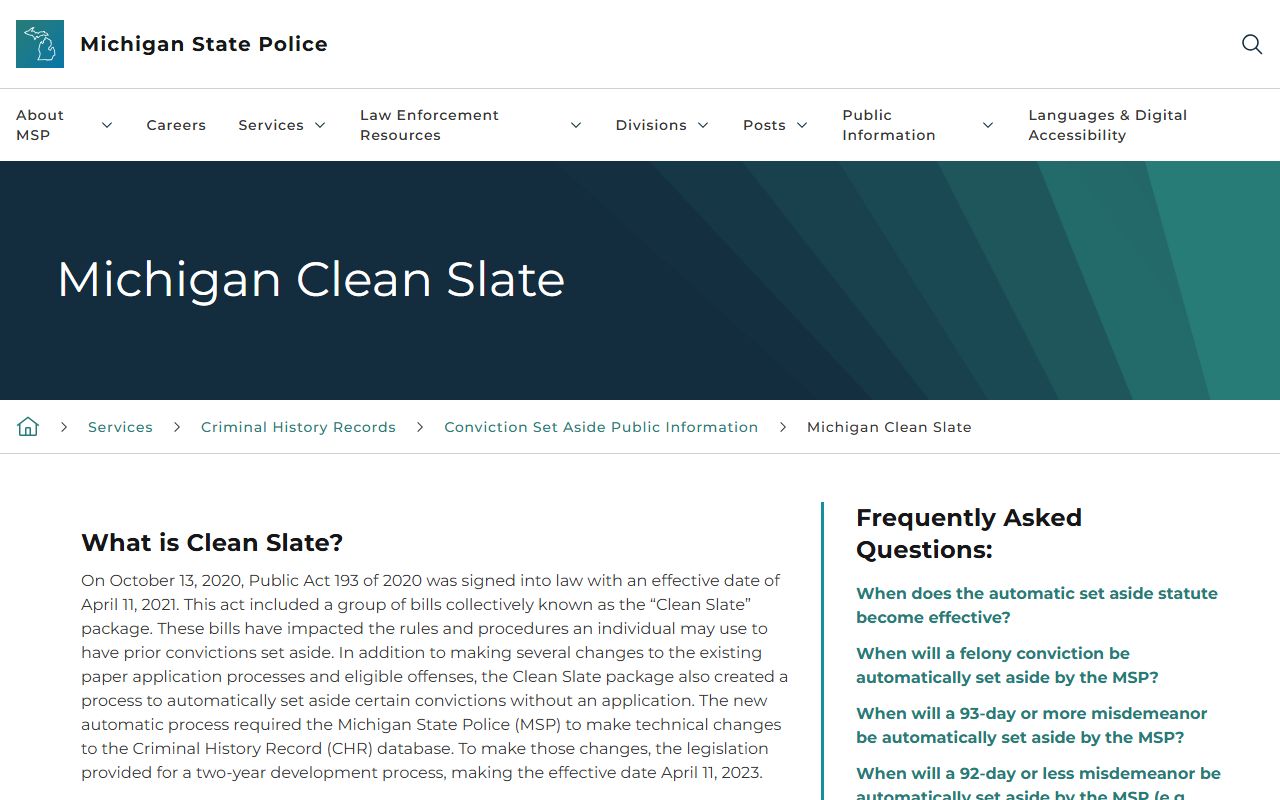
Because some court-only convictions must still be set aside by a judge, checking the program details prevents a false read that everything clears on its own.
Note: Clean Slate does not erase serious offenses, and an automatic set-aside can take time to show up across every public database.
Public Access to Luce County Criminal Records
Criminal case files in Luce County are public by default. Michigan Court Rule 8.119 governs court records and keeps most Luce County case files, dockets, and orders open for public inspection. That rule, MCR 8.119, also covers how clerks handle copying and how records get sealed. Court files fall under the court rules first, while county administrative records fall under Michigan's Freedom of Information Act.
The right to inspect and copy those non-court public records comes from MCL 15.233, which lets a person request records from a public body in writing. For a court file, request from the court that holds it. County Clerk Sharon J. Price keeps circuit criminal records, and the 92-1 District Court keeps district and misdemeanor files. Both sit inside the courthouse at 407 West Harrie Street in Newberry.
Background Check Considerations
A casual name search of Luce County criminal court records is not the same as a formal background check. Employers, landlords, and licensing bodies that run background checks must follow the federal Fair Credit Reporting Act. That law sets rules for accuracy, notice, and consent. A public records lookup done out of personal curiosity does not carry those duties, but it also does not meet the FCRA standard for a hiring or housing decision.
Important: This site is not an FCRA-regulated consumer reporting agency, and its records may not be used for employment, tenant, credit, or insurance screening decisions.
Restricted Criminal Court Records in Luce County
Some Luce County criminal court records stay out of public view entirely. Juvenile cases lead that list. Michigan law keeps most juvenile files confidential, and court staff may answer that there is no public record. Sealed adult files, active investigations, and protected personal data also sit behind limits. The court can withhold or redact these records even when the rest of a case is open.
Juvenile confidentiality rests on MCL 712A.28, which restricts public access to cases brought under the Juvenile Code.
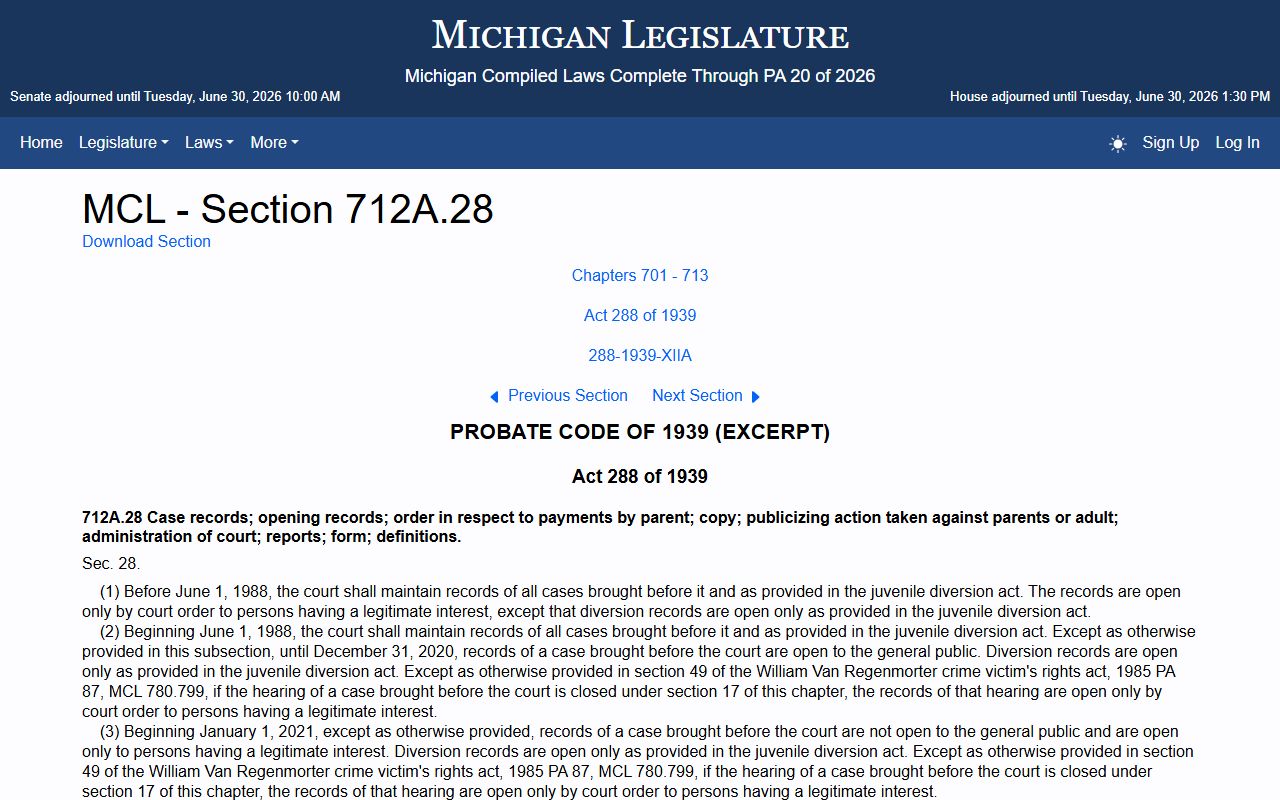
Access to those files is usually limited to the parties, their attorneys, people with a legitimate interest, or anyone the court allows by order.
Several categories of Luce County criminal and related records carry access limits:
- Juvenile delinquency and child protective cases under MCL 712A.28.
- Adult files sealed by court order under MCR 8.119(I).
- Set-aside convictions removed from public results.
- Protected personal data, such as Social Security numbers and birth dates.
- Ongoing matters the court has not yet made public.
Note: A missing online entry does not always mean a Luce County criminal court record was destroyed, since it may be sealed, set aside, or not yet uploaded to MiCOURT.